Why Public Bodies Publish Minutes
Why public bodies publish minutes: see how an official record supports accountability, lets residents question institutional memory and keeps decisions traceable.
When a council changes a bus route, its published minutes help residents see how the institution recorded that choice and who is responsible for keeping the record. Why public bodies publish minutes is not simply a matter of remembering meetings: minutes make institutional memory visible and open to scrutiny.
Minutes give institutions a record they can be held to
A public body is made up of people whose roles and responsibilities change. A written record lets current members, staff and residents refer to the same account after a meeting has ended and its participants have moved on.
That shared reference matters when someone asks what the institution previously agreed, what it was asked to do, or which issue it left unresolved. Minutes make it possible to put those questions to the body with a specific record in hand, rather than relying only on someone’s recollection.
They also expose gaps in institutional memory. If a later decision appears to depart from an earlier commitment, a resident can compare the records and ask the relevant body to explain the change. The minutes do not settle every disagreement, but they give the question a public basis.
Minutes turn memory into an accountable record
An organisation can remember a meeting informally through emails, notes or the recollections of people who attended. Public minutes serve a different civic purpose: they create a record the institution makes available beyond its own staff and members.
That visibility gives the record a life beyond administration. Residents, journalists, community groups and future members can refer to what was documented without depending on a personal connection to someone in the room. The record can also help people identify which body handled an issue and where to direct a question.
Minutes are like a sign-in book for decisions, not a tape recorder. They mark what the institution records as its business while leaving out the texture of much of the conversation. That selectivity makes clear wording and access to related records especially important.
Publication lets residents question what the record leaves unclear
Public access is useful only if people can locate and understand the record. A clear meeting date, body name and subject heading help a reader find the relevant entry. Where minutes are published alongside reports or supporting papers, those documents can provide context that the minutes themselves do not contain.
Publication also makes the record open to challenge. A resident might notice that a promised report is not mentioned later, or that the minutes do not identify which committee took responsibility. The next step is to ask the relevant public body a focused question, referring to the meeting date and the wording in its record.
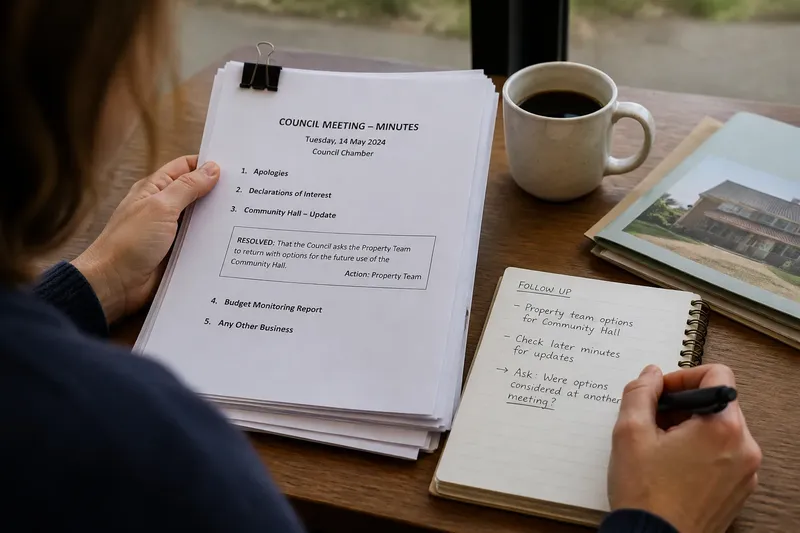
Say you are an invented resident following a council’s plans for a community hall. The published minutes say the council asked its property team to return with options, but a later set of minutes does not mention the hall. You note the meeting date and the action wording, then ask the council whether the options were considered at another meeting. The expected result is a specific clarification or a pointer to another public record, rather than an assumption that the work was completed or abandoned.
Public minutes raise questions about access and accountability?
Who can use published minutes?
Anyone who can access the public record can use it to understand what an institution documented about its work. Residents, community organisations and people who join the institution later all benefit from a shared account.
Why might a public body publish minutes online?
Online publication can make records easier to find without a visit or a direct request. The body’s website should identify the meeting and provide a route to related records where those are available.
Can minutes be corrected after publication?
Public bodies may have their own procedure for recording or correcting errors, so the route depends on the institution. If a detail appears wrong, contact the clerk or secretariat with the meeting date and the specific passage, and ask how corrections are handled.
What if a meeting record is hard to find?
Search the institution’s website using the body name, meeting date and topic, or contact its clerk or records office. Ask for the relevant record and whether related papers are published separately.
Check how the record is maintained and shared
When you want to understand whether a public record supports accountability, look for practical details rather than assuming publication alone answers every question:
- Check that the meeting date and public body are named. If both are clear, use them to identify the record in a follow-up; if either is missing, ask the clerk or secretariat to confirm which meeting the document covers.
- Check whether the record is labelled as a draft or an approved version. If its status is clear, cite that status accurately; if it is unclear, ask whether a later approved record exists before treating the wording as settled.
- Check whether the document can be found on the institution’s website. If it is accessible, share the record with anyone you are discussing it with; if the link is broken or the file is absent, ask the body how to obtain a working copy.
- Check whether related reports or papers are linked. If they are, read the relevant paper to understand what information was available; if not, ask whether supporting papers are held or published separately.
- Check whether an action identifies a responsible role or body. If it does, direct a follow-up question to that role or body; if it does not, ask the clerk who is responsible for tracking the action.
- Check whether the record states how to raise a possible error. If it gives a correction route, use that procedure and identify the passage; if it does not, ask the clerk or secretariat what process applies.
Why public bodies publish minutes becomes clearer when you see them as part of a public relationship: the institution records its work, and people outside it can inspect, question and refer to that account. A useful record does not need to reproduce every conversation; it does need to remain findable, attributable and open to a clear question when something is missing.