What “Approved” Means in a Public Decision
Learn what “approved” means in a public decision by identifying the object, decision-maker and limits, so you can describe the outcome accurately.

A council notice says a proposal was “approved”, and a neighbour asks whether the work is going ahead. What “approved” means in a public decision depends on what was agreed, who made the decision and what the record leaves open.
The word can describe support for an idea, permission to take a next step or agreement to a specific action. Read it as a signal to check the decision’s boundaries, not as a complete account of what will happen.
Identify what the decision approves
Imagine a wholly invented situation: Alder Ward Council is considering a safer crossing near a library. A brief notice says, “Library crossing proposal approved.” Residents might reasonably wonder if construction is now settled. The notice does not say what the decision concerns.
In this imagined case, the formal resolution authorises staff to prepare a design and report back. It does not approve a finished design or authorise construction. The decision is real, but its object is design work, not the completed crossing.
Approval can apply to different things: a draft for further consideration, a recommendation to another body, funding for a stated purpose, a limited trial, or a final plan. Look for the noun that follows “approved” and the action words around it, such as “prepare”, “recommend”, “consult” or “deliver”. They help show whether the decision concerns investigation, advice, spending or implementation.
A useful plain-language account names the object directly: “The committee approved a request to prepare design options.” That is more informative than repeating “the proposal was approved” without saying which part of it.
Check who made the decision and what their authority covers
A public announcement may name an institution without explaining which person or body made the decision. The relevant arrangements differ between public bodies, so do not assume that every council, committee or officer has the same powers. Check the applicable decision record and, where needed, the body’s published scheme of delegation.
In the invented Alder Ward case, the notice alone does not establish who can approve a road layout or authorise construction. The reader would need to check the council’s own records and rules to identify the responsible decision-maker and any later approvals. No particular division of authority should be inferred from the fictional example.
Keep the types of statement distinct. A report may recommend an action; a chair may announce an outcome; a formal resolution records what the authorised decision-maker agreed. Their significance depends on the local procedure and the document’s status. If authority is unclear, ask the public body to identify the decision-maker and the rule or delegation relied on.
Read the conditions and boundaries
An approval may apply only to a defined purpose, option, location or set of conditions. The record might also require more information or another decision before work proceeds. These limits are part of the decision, not incidental wording.
In the fictional crossing case, imagine the resolution authorises staff to develop one design option, subject to checking access for nearby shops, and asks them to return with a further report. The observable result is that design work may continue under the terms recorded; the final layout and any construction decision remain unresolved. This example describes no real council procedure.
Look closely at phrases such as “subject to”, “in principle”, “for the purpose of” and “following further assessment”. Ask what each phrase permits, requires or leaves undecided. If the record refers to a technical specification, adopted policy or formal power, consult the linked material when the precise boundary matters.
Use a focused check before describing an approval
For a quick, careful reading, check the record for each of these points. If a detail is absent or ambiguous, follow the alternative action rather than filling the gap with an assumption.
- Check the exact object named in the resolution; if it is a report or design task, describe that task rather than saying the whole project was approved, and if the object is unclear, ask the public body to clarify it.
- Check which person or body recorded the decision; if the record names an authorised decision-maker, attribute the decision to that body, and if authority is uncertain, consult the delegation rules or request clarification.
- Check whether the wording is a recommendation, announcement or formal resolution; if it is only a recommendation, call it advice, and if the outcome is missing, find the decision record.
- Check for conditions such as “subject to” or “following review”; if a condition remains outstanding, say so, and if its effect is unclear, read the linked document or ask the responsible body.
- Check for a named next step or later approval; if one is required, distinguish it from the decision already made, and if no next step is recorded, do not invent one.
- Check the document’s date and status; if it is a later update rather than a new resolution, describe it as an update, and if the sequence is unclear, compare the meeting date with the publication date or seek confirmation.
Follow the record without confusing documents
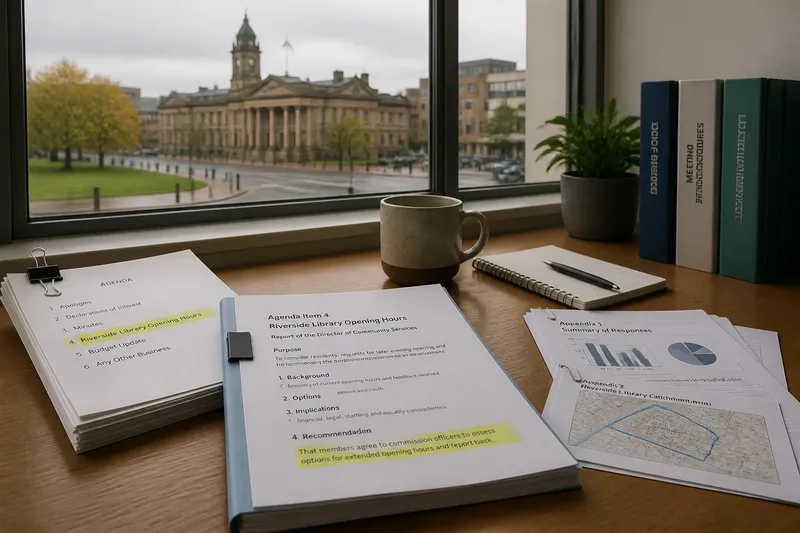
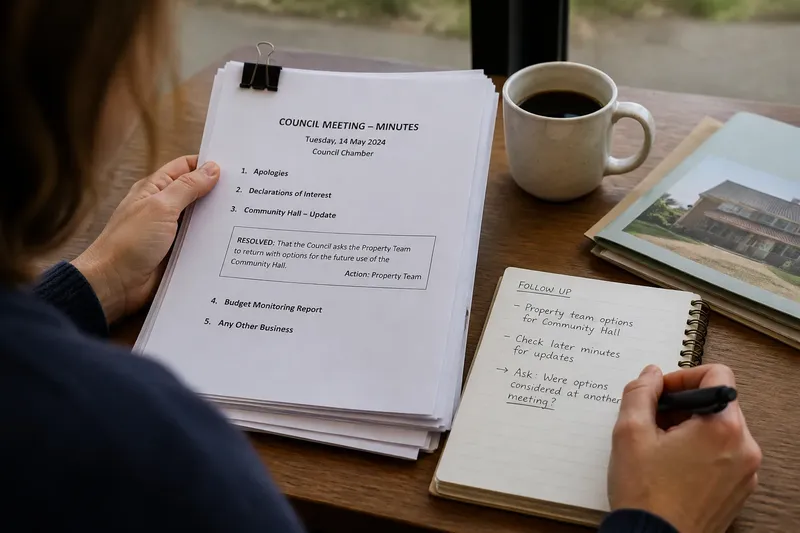
A proposal, officer report, resolution, public notice and later update may all discuss the same matter. They do not necessarily record separate votes. A report can set out options and recommend one; the formal decision record is where to look for what the authorised decision-maker agreed.
Imagine a reader finds the short crossing notice, then opens the meeting papers. The report recommends preparing one design option, while the resolution directs staff to develop it and return with further information. A later update says the assessment is ongoing. Read together, these records support a precise account: design work was authorised, while the final layout and construction remain unsettled.
Check each document’s date and status. A notice published after a meeting may summarise a decision made at that meeting; its publication date does not by itself change when the decision occurred. If a later document appears to alter the scope, check whether it records a new decision or explains work already authorised.
Which questions clarify what approved means?
Does “approved in principle” mean the project is final?
Not by itself. The phrase may indicate agreement with a broad direction while details, conditions or further permissions remain open. Check the resolution for anything still subject to review.
Is a recommendation the same as approval?
No. A recommendation advises a decision-maker, while approval is the decision recorded by the person or body with authority. Check the outcome in the formal record rather than treating a report’s recommendation as the result.
Does an approved budget mean the work will happen?
It establishes only what the budget record says was approved, which may be funding for a defined purpose rather than every permission needed to deliver work. Check for conditions, spending limits and further decisions.
What should I do if a notice says more than the resolution?
Compare the two and describe only what the formal decision supports. If the difference affects a practical or legal right, ask the responsible public body for clarification or consult a qualified professional.
Describe the decision in precise terms
When you see “approved”, state the object, the decision-maker and any limits or next steps that the record supports. In the invented crossing situation, that could read: “The record authorises design work on a crossing; it does not settle the final layout or construction.”
This is the useful meaning of “approved” in a public decision: a recorded agreement with a particular scope, made under a particular body’s procedures. If you cannot establish one of those parts from the available record, say what remains unclear and ask the institution responsible to identify it.