A First Read of a Draft Public Plan
A first read of a draft public plan helps you identify affected people, supporting evidence and unanswered trade-offs before you decide what to comment on.
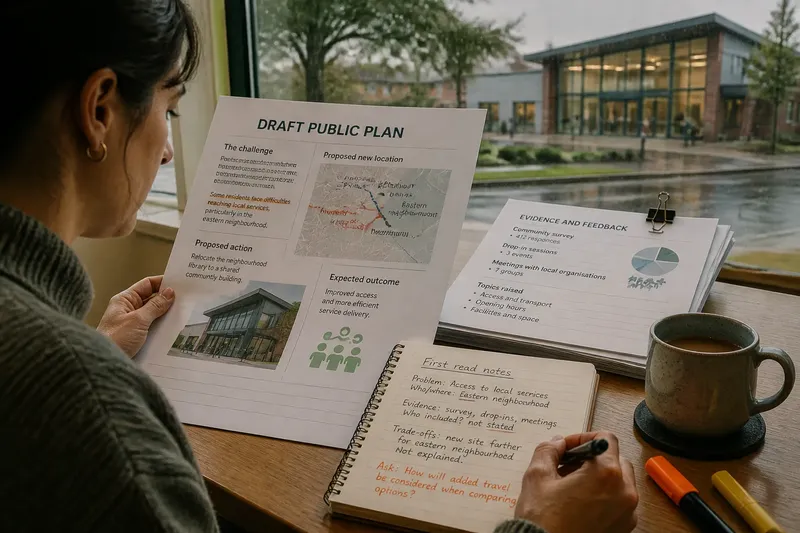
A draft public plan becomes easier to assess when you trace how it connects a stated problem to the people affected and the evidence used to support its choices. On a first read of a draft public plan, look for those links rather than treating the document as a list of promises.
Trace the problem through the plan
Find the passage that describes the problem, then check whether the plan identifies who experiences it and where. A council might say that residents have difficulty reaching local services. Look for any account of which services, neighbourhoods or groups the statement concerns; without that context, it is hard to judge whether the proposed response fits.
Next, follow the document from problem to action. Does it explain why the proposed change is expected to address the stated need? A plan might call for moving a service, but the reasoning should make clear how a new location relates to the access problem it describes.
Keep the problem, proposed action and expected outcome distinct. If the plan says it aims to improve access, a new building is an action, not proof that access will improve. This distinction helps you comment on the reasoning rather than simply endorsing or rejecting a slogan.
Check whose experience appears in the evidence
Look for the sources behind claims about public needs. A plan may refer to survey responses, service records, meetings or feedback from local organisations. Note whose views are represented and whose experience may be missing. The document may not answer that question, but recording the gap gives you a focused point to raise.
Check whether the evidence is described clearly enough to understand its limits. For example, a summary of public feedback may name the topics raised without explaining which communities contributed. Ask what the document tells you about how that feedback was gathered and how it informs the plan.
Do not treat an unmentioned group as proof that the plan ignored it. Instead, distinguish what the document says from what you still need to know. That careful wording makes your comment more useful to both the public body and other readers.
Follow the trade-offs behind the preferred approach
Plans often describe benefits more clearly than the costs or burdens of a proposed change. Look for discussion of who may need to travel farther, adjust to a new service, or give up an existing arrangement. The relevant trade-off depends on the plan, so check its maps, appendices and descriptions of current provision.
Say you are reading an invented draft that proposes moving a neighbourhood library service into a shared community building. The draft says the move could make staffing easier, but its map shows the new site farther from the eastern neighbourhood. You note that the document explains the staffing rationale but does not describe how the added travel would be considered; your comment can ask for that impact to be addressed before the options are compared.
Compare the plan’s account of benefits with its account of burdens. If one side is explained and the other is not, ask for the missing comparison rather than assuming the choice is unfair or settled.
What can the plan’s evidence tell you?
How do I check whether a claim is supported?
Find the source or explanation attached to the claim, such as a map, service record or consultation summary. If the plan gives no source, ask what information supports the statement and whether it will be made available.
What if different parts of the plan seem to conflict?
Note the exact passages, table entries or map labels that do not appear to fit together. Ask which account should guide the decision and whether the document will be corrected or clarified.
How can I tell whether a group’s experience is missing?
Compare the people and places named in the plan with those affected by the proposed change. If the document does not explain whose views informed it, ask how affected groups were included or how their experience will be considered.
Should I comment if I cannot judge the evidence yet?
Yes: separate the point you understand from the information you still need. Ask for the source, explanation or comparison that would let you assess the proposal, rather than presenting an unanswered question as a settled finding.
Turn an observation into a clear comment
A focused comment connects a passage in the plan to a specific concern or request. Keep one issue in each comment where possible, and identify the page, map or section that prompted it. Then say what explanation, evidence or change would help.
- If the plan names a problem but does not identify the affected places, ask which neighbourhoods the claim covers; if that information appears elsewhere, cite that section and ask how it informs the proposal.
- If a map shows a service moving farther from some residents, ask how that change will be considered; if the plan already discusses access, point to the missing group or location instead.
- If the plan cites public feedback without describing who contributed, ask how views were gathered; if a method is described, ask how the responses shape the proposed approach.
- If the document lists benefits but not burdens, ask for the relevant trade-offs to be explained; if those burdens are covered in an appendix, identify the passage that needs clearer connection to the main proposal.
- If two sections describe the same change differently, quote or identify both and ask which account is current; if one is plainly marked as background, ask for the distinction to be made clearer.
- If a claim has no visible supporting source, ask what evidence underpins it; if the source is linked but difficult to interpret, ask for a plain-language explanation of how it informs the plan.
For instance, you could write: “The draft says the proposed library move would improve access, but the map places the new site farther from the eastern neighbourhood. Please explain how travel from that area will be considered when comparing the options.” The comment identifies the claim, the detail that complicates it and the information requested.
Keep your first-read notes tied to the document
As you read, make a short record of the stated problem, the evidence cited, the people or places affected, and the trade-offs the plan explains or leaves unclear. Add page numbers or section names so you can return to the relevant text without relying on memory.
A draft public plan is easier to comment on when your observations stay close to what its pages actually say. Keep the distinction between documented evidence and unanswered questions in your notes; it lets you ask for a clearer account without claiming more than the plan supports.