What an Agenda Item Can Tell You Before the Meeting
Learn how to read an agenda item, its report and attached papers to identify the decision being considered—and distinguish a proposal from an outcome.
An agenda item can tell you what a public body is being asked to consider, but its heading alone rarely tells the whole story. To understand the question before a meeting, read the heading alongside the report, its recommendation and any attached papers. That small habit helps distinguish a request for a decision from a report about something already decided.
Read the heading as a signpost, not a verdict
Agenda headings are usually brief. They may name a place, a service, a policy or a process: “Riverside library”, for instance, or “Changes to parking arrangements”. The heading helps you locate the subject, but it may not say what the members are being asked to do.
Look for a verb. Words such as consider, note, approve, recommend and receive suggest different kinds of business. Even then, a verb is a clue rather than a complete account. “Consider revised opening hours” leaves open whether the body will choose hours, request more work or simply discuss options.
Notice also whether the heading names a particular decision-maker or body. A committee may be asked to recommend a course of action to a council, while the council retains the authority to decide. The meeting paper should explain that relationship; the heading may not have room to do so.
The report explains the question beneath the title
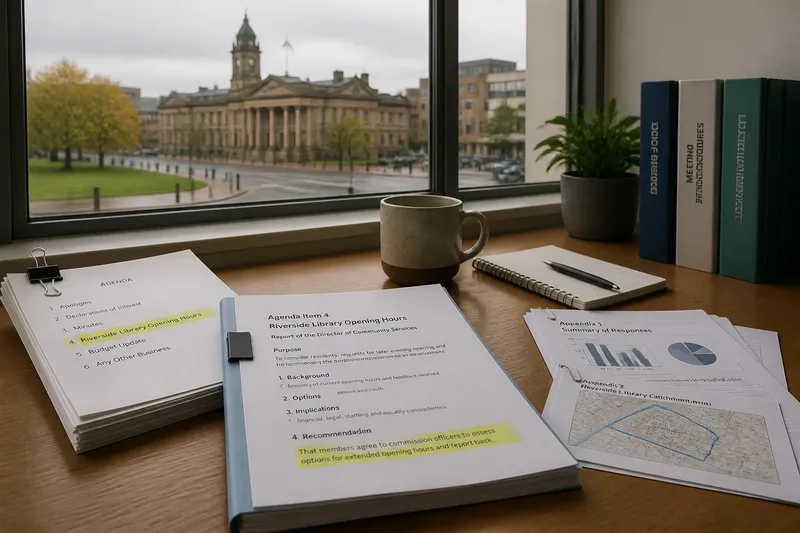
The report is often the most useful part of an agenda item. Start with its purpose or summary, then look for sections headed “Background”, “Options”, “Implications” or similar. These parts give context and show what choices are in front of the members.
Ask yourself three plain questions as you read:
- What situation or request brought this item forward?
- What action, if any, is the meeting being asked to take?
- Who would act next if the members agreed?
The report’s recommendation is especially important, but it is not the same as the body’s decision. It is the officer’s or author’s proposed course. Members may accept it, amend it, reject it, defer the matter or ask for further information, depending on the body’s powers and meeting rules.
Imagine a report headed “Riverside library opening hours”. It describes residents’ requests for later evenings and recommends asking staff to assess the practical options before a future decision. The title might sound like a decision about hours is due, but the recommendation shows that the immediate question is whether to commission further work.
Attached papers show where the recommendation comes from
Attachments can supply the detail that a short report cannot carry. They might include a map, a draft policy, a summary of responses, a financial note or a proposed timetable. Read the attachment named in the report rather than assuming every paper in the bundle has equal relevance.
Check how the report describes each attachment. A draft policy is not necessarily the policy being adopted; a map may show an option rather than a final boundary. Labels such as “draft”, “for discussion” and “appendix” help explain a paper’s role, but the report should connect it to the requested action.
When a report refers to a paper you cannot find, note the gap rather than filling it with an assumption. The public body’s agenda page may list attachments separately or provide a combined document. If the missing material matters to understanding the recommendation, you can ask the relevant committee clerk or public contact where it is available.
Think of the agenda pack as a set of nested envelopes: the heading points to the parcel, the report explains what is inside, and the attachments show supporting detail. Opening only the first envelope can leave the actual question hidden.
Separate a proposal from an outcome
Public documents use several stages of decision-making, and similar wording can appear at more than one stage. A report may recommend an option; a committee may recommend it onward; another body may make the final decision; staff may then carry it out. Identifying the stage prevents a proposal from being mistaken for a settled outcome.
Look for signs of what remains to happen. Phrases such as “subject to council approval”, “for recommendation”, “seeking authority” or “to be considered at a later meeting” indicate that another step is expected. Conversely, a report may describe an earlier decision as background while asking members to deal with a separate issue now.
Also distinguish the action requested from its likely effects. A recommendation to consult on a change does not itself make the change. A request to prepare a final plan does not necessarily adopt that plan. The exact meaning depends on the body’s authority and the wording of the proposed resolution.
How should you read an agenda item?
What does “to note” mean?
It usually asks members to receive or acknowledge information, rather than choose a new course of action. Read the recommendation and any proposed resolution to see whether the item also asks for another action.
Does a recommendation mean the decision is made?
No. A recommendation expresses a proposed course, and members may handle it differently. Check which body has authority to decide and whether the report identifies a later approval stage.
Why are there several papers under one agenda item?
The report may set out the issue while attachments provide evidence, options or draft wording. Follow the report’s references to see which paper supports which part of the request.
What if the agenda heading seems vague?
Read the report’s purpose, recommendation and proposed resolution, if one is included. If those still do not make the requested action clear, the meeting’s published rules or the committee clerk may help explain the item’s scope.
Use the proposed resolution to pin down the action
Some agenda packs include draft wording for the decision, often called a recommendation or proposed resolution. Read it closely. It can reveal whether members are being asked to approve a document, request further work, delegate a task or pass a recommendation to another body.
Compare that wording with the report’s explanation. If the report describes several possible options but the proposed resolution selects one, the meeting may be asked to choose that option. If the wording asks members to “receive” a paper and “request a further report”, the immediate action is narrower than a final policy choice.
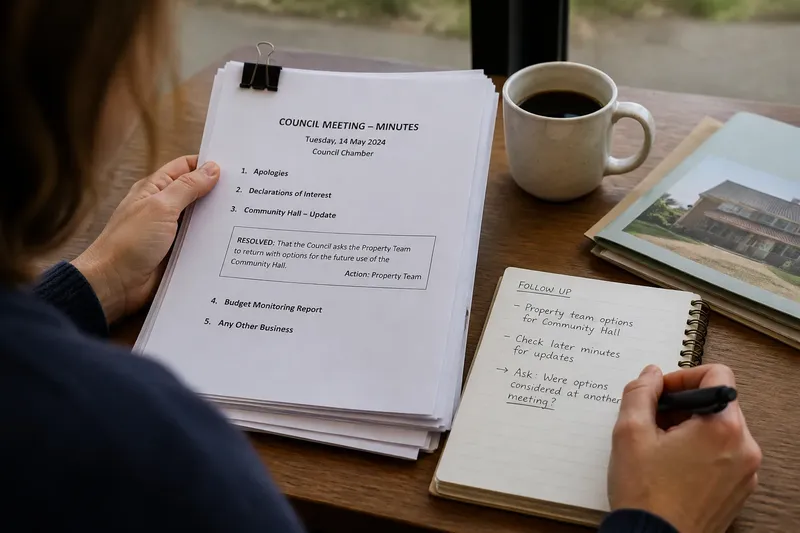
Do not treat draft wording as proof that the body will adopt it. It is the starting text for consideration, and the final wording may change during the meeting. Later records, such as the decision notice or published minutes, can show what action was actually agreed. Those records answer a different question from the agenda: not what was proposed, but what followed.
Make a useful note before the meeting
A concise note can keep the papers readable without turning your preparation into a research project. Record the issue, the action requested, the body expected to act and any unresolved point. If the report relies on an attachment, note its title too.
- Subject: What service, place or policy is under discussion?
- Requested action: What does the recommendation or resolution ask members to do?
- Decision stage: Is this a final decision, a recommendation onward or a request for more work?
- Supporting paper: Which attachment explains the options or proposed wording?
- Open question: What remains unclear from the published material?
This is a reading aid, not a substitute for the meeting’s rules or the full report. A title that sounds decisive may lead to a request for further analysis; a plain heading may contain a specific choice. Reading the papers in order lets you see the agenda item as a question with a stated next step, rather than as a headline that already contains its answer.
When you search for how to read an agenda item, keep one distinction in view: the papers show what the body is being asked to consider, while the later record shows what it actually did. That makes it easier to follow the path from proposal to decision without confusing the two.